







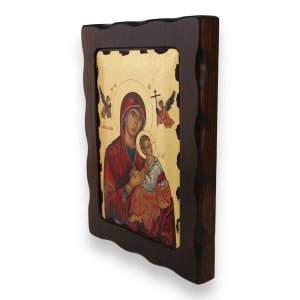
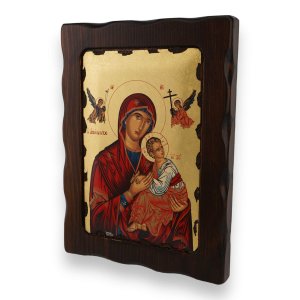
Theotokos of the Passion Icon (Amolyntos) – Carved Frame
$108.99
Byzantine icon of the Theotokos of the Passion (Amolyntos), handcrafted in Greece with gold leaf.
Dimensions: 17 x 23 cm (6.7 x 9.1 in); about 2.5 cm (1 in) thick
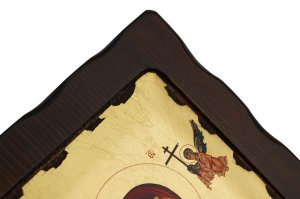
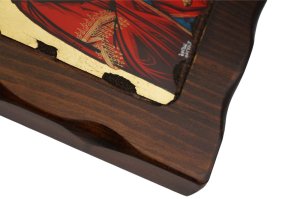
Materials: gold leaf, gessoed canvas, solid wood panel with a hand-carved frame, protective varnish
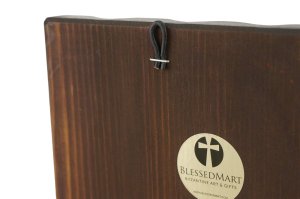
Details: metal hanger on the back; certificate of authenticity
✓ Estimated shipping time: 1-2 days
10% OFF AND FREE EXPRESS
Offer valid when you order 2 or more icons from the Orthodox Icons collection.
In stock
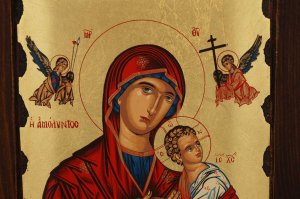
The Theotokos of the Passion, called in Greek Amolyntos, “the Undefiled”, shows the Christ Child seeing the instruments of His future sufferings. The image took shape in Cretan iconography in the fifteenth century and spread widely in both East and West.
Iconography and Symbolism
In the upper corners two angels carry the instruments of the Passion: one the cross, the other the spear and the reed with the sponge. The Child has turned His head towards them and holds on to His Mother’s hand, and the sandal has slipped from His foot, a sign of a child’s fright and of His true human nature. The letters MP ΘΥ abbreviate the Greek Μήτηρ Θεοῦ, “Mother of God”, and IC XC abbreviate the name Jesus Christ. On the left is written Ἡ Ἀμόλυντος, “the Undefiled”.
Veneration
The image is honored on all feasts of the Theotokos, most solemnly on her Dormition, August 15 (August 28 for churches on the Julian calendar). The Russian Church also keeps a feast of this icon on August 26 (August 13 on the Julian calendar). According to Tradition, the faithful pray before it in trials, illness and fear. The icon is a fitting gift for a baptism and for someone close in a difficult time.
Handcrafted in Greece
Every BlessedMart icon is handcrafted in Greece by artisans with more than twenty years of experience. The solid wood panel is cut and its frame is carved and darkened by hand, so no two frames are exactly alike. The image, printed on gessoed canvas with gold leaf, is set into the panel and sealed with varnish that protects the image, including from holy water when the icon is blessed. Where the design calls for it, finishing touches such as the red border line and fine details are painted by hand. Most designs are reproductions of our own hand-painted icons, which follow the canons of Orthodox iconography. The inscriptions are in Greek, as on the original. Each icon is inspected before shipping, packed in several protective layers, and comes with a certificate of authenticity. To care for it, keep it away from heaters and damp, and clean it only with a soft, dry cloth.
The best-known icon of this type has been in Rome since the fifteenth century, now in the Church of St Alphonsus.
| Technique | Reproduction |
|---|---|
| Subject | |
| Dimensions | 17 x 23 cm (6.7 x 9.1 in) |
| Artist Country |
Add a review
Question about Theotokos of the Passion Icon (Amolyntos) – Carved Frame
Related products


1 review for Theotokos of the Passion Icon (Amolyntos) – Carved Frame